How to start running: A guide for beginners

Starting running as a beginner does not need to be intimidating. This guide shows you how to begin with the run walk method, build confidence, stay motivated, and make running feel doable in real life. You will finish with a simple plan and a clear reason to keep going.
Summary
Use the run walk method to start safely
A simple beginner running plan you can repeat
How to stay motivated, even when you cannot be bothered
Confidence tips that actually work
Running with a friend (and how to make it easier)
FAQs
Before you start: what you actually need (and what you do not)
You do not need fancy gear, a perfect routine, or “runner confidence” to begin. You need a starting point that feels manageable.
The basics
Comfortable trainers (ideally running shoes if you have them, but do not let this delay you).
Clothes you can move in and that suit the weather.
A route that feels safe and easy to return from. A park loop is ideal.
A plan that starts small, so you finish feeling capable, not crushed. If you go from never running, to trying to train for a marathon, you’ll become overwhelmed!
Optional extras
A smart watch: This will help you track your runs and see progress, as well as keeping an eye on distance and heart rate.
Strava: There are other platforms where you can track progress, but we think this is the best. The social aspect and having everything in one place will really help with motivation.
A quick readiness check
If you have a medical condition, are returning after injury, or feel unsure, it is sensible to check with your GP before increasing activity. Most beginners, though, can start with short run walk intervals at an easy effort.
Run walk method: the beginner-friendly way to start running
If you only take one thing from this post, make it this: start with run walk. It is simple, proven, and far easier to stick with than trying to run nonstop on day one. This is also a method a lot of elite-level ultra runners use for long distance running, so don’t feel like you’re cheating!
What is the run walk method?
You alternate short periods of running with walking breaks. This keeps effort under control while your lungs, legs, and joints adapt.
Why it works
Builds fitness without battering you: walking breaks reduce strain.
Keeps you consistent: you are less likely to dread the next session.
Improves confidence quickly: finishing feeling “I can do this” matters.
Teaches pacing: beginners often start too fast. Run walk solves that.
What “easy” should feel like
Aim for an effort where you can speak in short sentences. If you are gasping, slow down. You are not failing. You are learning the right pace.
If you track heart rate, try to stay in zone 2, you can work out your heart rate zones here, but you don’t have to worry about this too much just yet.
A great first session (20 to 25 minutes total)
5 minutes brisk walk to warm up
10 rounds of: 30 seconds gentle jog + 60 to 90 seconds walk
5 minutes easy walk to cool down
If 30 seconds feels too much, do 15 to 20 seconds. The plan should fit you, not the other way round.
A simple beginner running plan (repeatable, no drama)
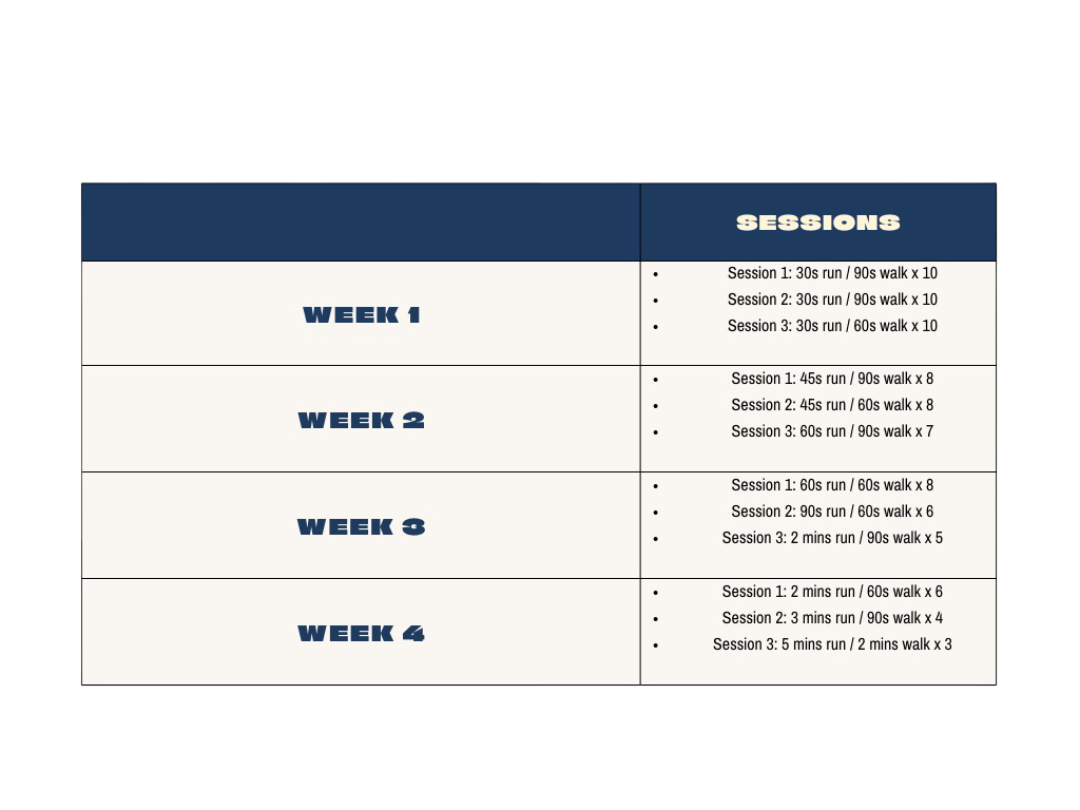
Here is a straightforward 3 days per week plan. Rest days matter. They are part of training and help your body adapt.
Two key rules
Keep the running easy. Speed is not the goal yet. Drop. Your. Ego. No one cares how fast you’re running, and running slower will help you progress.
Repeat weeks if needed. Progress is not linear, and that is normal.
Optional add-on
On 1 to 2 non-running days, do a 20 to 30 minute walk. It supports fitness and recovery without adding stress.
How to avoid beginner mistakes that kill motivation
1) Starting too fast
Most beginners run their “hard pace” by accident. Slow down until it feels almost silly. You will improve faster because you will recover and show up again.
2) Doing too much, too soon
Your lungs may feel ready before your tissues do. Tendons and joints take time to adapt. Run walk and rest days are how you stay injury-free.
3) Thinking you must run a certain distance
Distance goals are fine later. Early on, focus on time and consistency. Ten minutes of run walk counts.
How to stay motivated (even when you cannot be bothered)
Motivation comes and goes. Systems last. Here is how to build a setup that makes running easier to repeat.
Make it small enough to start
Your goal should be so easy you can do it on a low-energy day.
“I will put my kit on and walk for 10 minutes.”
If you feel good, you continue.
If you do not, you still won because you kept the habit alive.
Keep a “done list”
Instead of obsessing over what you have not done, track what you did:
Date
Session (for example: 30/90 x 10)
One sentence: “Felt better after 5 minutes.”
This is confidence-building data. It also helps with AEO style questions like “How do I know I am improving?” because you can literally see it.
Use simple rewards
Nothing fancy. After your run:
A good coffee
A hot shower
Ten minutes guilt-free scrolling
Your brain learns running leads to something pleasant.
Have a plan for bad weather
UK weather is not always inspiring. Decide in advance:
Light rain: go anyway, wear a cap
Heavy rain: swap for a brisk walk or indoor cardio
Ice: do not risk it, choose safety
You are building consistency, not proving toughness.
One of our favourite quotes is Discipline > Motivation. You won’t always be motivated, but discipline will help you push through.
Building confidence: how to feel like a runner before you “look like one”
Confidence is rarely a feeling you wait for. It is usually something you build through repetition.
Reframe what success looks like
Success is not “I ran nonstop”. Success is:
I showed up.
I followed my plan.
I finished feeling capable.
That is how beginners become runners.
Keep your pace private
If tracking stats makes you compare yourself, switch it off for a few weeks. Or track only time spent moving. Confidence grows faster when you stop grading every session.
Use the “talk test”
Ask: “Could I speak a sentence?”
If yes, you are at a good beginner effort.
If not, slow down.
This protects your confidence because the run feels manageable.
Expect the first 5 to 10 minutes to feel awkward
This is normal. Your body is warming up. Your breathing settles. Most beginner runs feel better after the initial wobble.
Running with a friend: the easiest accountability hack
If motivation is your sticking point, a running buddy is a shortcut.
Why it helps
You are less likely to cancel.
It feels more social, less like a chore.
Chatting keeps the pace easy, which is ideal for beginners.
How to make it work (without pressure)
Agree the session is run walk from the start.
Choose a loop route so nobody feels “stuck far away” when tired.
Set a time cap (for example 25 minutes total). It feels achievable.
If you do not have a running mate
Try:
A local beginners running group. Parkrun is also a great option.
A workplace buddy at lunchtime
A family member for the walking intervals
The point is support, not performance.
Your “why”: the most underrated motivation tool
When enthusiasm fades, your reason keeps you moving. Your “why” should be personal and specific.
Examples that work
“I want more energy for my kids.”
“I want to feel calmer and sleep better.”
“I want to finish a 5K in spring.”
“I want to prove to myself I can stick with something.”
Turn it into a one-line commitment
Write one sentence you can remember on a bad day:
“I run to feel like myself again.”
“I run for future me.”
Put it somewhere visible. Phone lock screen works well.
Pair your “why” with a next milestone
Milestones keep training focused:
Your first 20 minute continuous run
Your first Parkrun (walking breaks allowed)
A local 5K event
Practical tips: breathing, pacing, and recovery
Breathing
Beginners often hold tension in their shoulders and chest. Try:
Relax your shoulders
Breathe into your belly
Slow down until breathing settles
If you can talk in short sentences, you’re doing it right.
Pacing
Think “gentle jog”, not “sprint”.
A good beginner pace often feels like you could go faster. That is perfect.
Recovery
On rest days:
Walk
Stretch lightly if it feels good
Sleep as well as you can
If something hurts sharply or worsens each run, pause and reassess.
What if you miss a week?
You have not failed. Life happens.
If you miss a few days, repeat your last session.
If you miss a week or more, drop back one week in the plan.
Keep it easy for 1 to 2 sessions, then build again.
Consistency over perfection. Always.
FAQs
-
Most beginners do well with 3 short run walk sessions per week, with rest days between. This gives your body time to adapt and reduces injury risk.
-
No. It is a smart training method used by beginners and experienced runners alike. Walking breaks help you build endurance safely and keep sessions consistent.
-
Many beginners can build towards a 5K over 8 to 12 weeks, depending on starting point and consistency. There is no prize for rushing. Repeat weeks if needed.
-
Feeling self-conscious is common. Choose quiet routes, wear what feels comfortable, keep the pace easy, and focus on finishing. Confidence follows action.
To Conclude
Starting running as a beginner is not about pushing through misery. It is about building a habit that fits your life. Use the run walk method, keep the pace easy, and focus on showing up three times a week. Confidence and fitness will follow.You’ve got this!